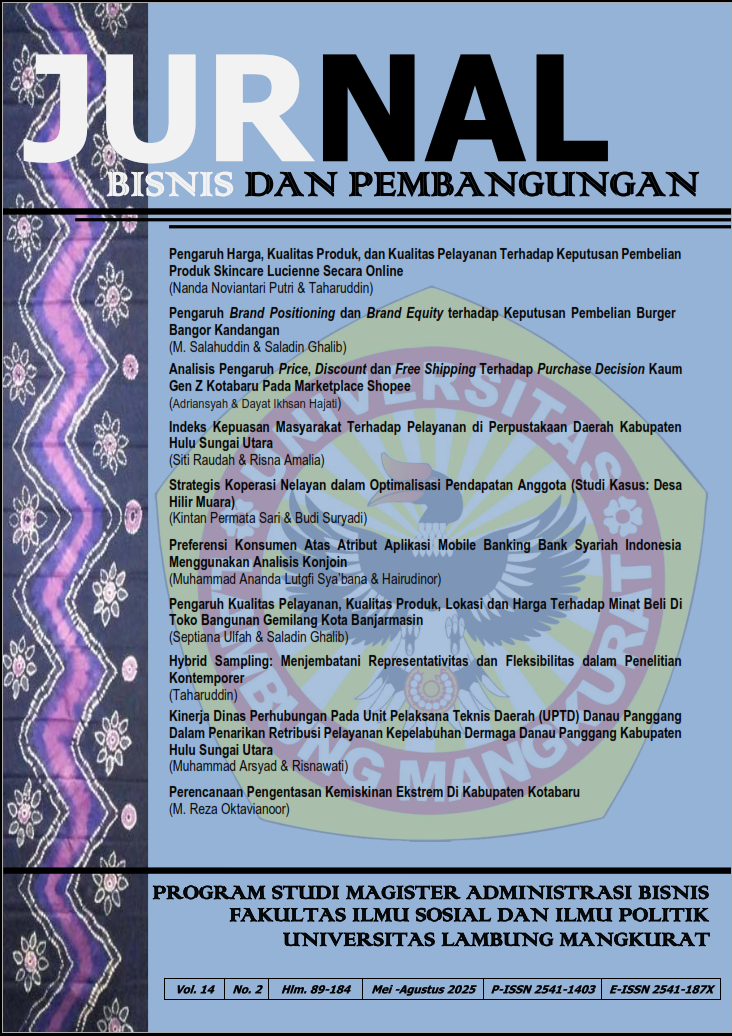
Strategis Koperasi Nelayan dalam Optimalisasi Pendapatan Anggota (Studi Kasus: Desa Hilir Muara)
DOI:
https://doi.org/10.20527/jbp.1414i2.90Keywords:
Member Income, SWOT Strategy, Fishing Technology, Coastal EmpowermentAbstract
Abstract: Kotabaru Regency, a Strategic Provincial Area for marine and capture fisheries, boasts significant potential, with a fishery production of 65,554 tons in 2023, the highest in South Kalimantan. Hilir Muara Village, located in Pulau Laut Sigam Sub-district, serves as a marine-based economic hub driven by fishermen cooperatives, with KUB Matahari Bersinar as the primary collective institution. Despite high production, fishermen‘s income remains low, ranging from IDR 1,500,000 to IDR 2,000,000 per month, below Kotabaru‘s minimum wage of IDR 3,462,000 (BPS, 2023). KUB Matahari Bersinar faces challenges, including limited working capital, weak managerial capacity, insufficient technical training, and low adoption of modern technology. Previous studies have largely focused on macro-level fisheries or national seafood exports, with limited research on strategies for small-scale local fishermen cooperatives. This study aims to identify the strengths, weaknesses, opportunities, and threats of the KUB Matahari Bersinar through a SWOT analysis. The analytical modeling produces a strategic matrix of SO–WO–ST–WT strategies based on IFAS–EFAS scores, and formulates cooperative strengthening strategies to optimize member income. Using a qualitative approach through interviews, observations, and document reviews, the study finds that strategies based on local potential—such as modernization of fishing technology, digitalization of management, and strengthening of market access—can improve the welfare of fishermen. The results of this study are expected to provide practical contributions to the development of fishermen cooperatives in Kotabaru Regency
References
Adawiah, R., & Wardhana, A. (2021). Analisis kompetitif dan spesialisasi sektor unggulan di Kabupaten Kotabaru. JIEP: Jurnal Ilmu Ekonomi dan Pembangunan, 4(2), 406–415. https://doi.org/10.20527/jiep.v4i2.4398
Fang, X., Zhang, Y., Yang, J., & Zhan, G. (2024). An evaluation of marine economy sustainable development and the ramifications of digital technologies in Meru coastal regions. Journal of Economic Analysis and Policy, 82, 554–570. https://doi.org/10.1016/j.eap.2024.03.022
Prahalad, C. K., & Hamel, G. (1990). The core competence of the corporation. Harvard Business Review, 68(3), 79–91.
Pemerintah Provinsi Kalimantan Selatan. (2021). Rencana pembangunan jangka menengah daerah (RPJMD) Provinsi Kalimantan Selatan tahun 2021–2026. Banjarmasin, Indonesia: Badan Perencanaan Pembangunan Daerah Provinsi Kalimantan Selatan.
Putri, A. A., Aryazeta, A. A., Fu’ad, Z., Ismikarimah, Devi, Y., & Kurniati, E. (2024). Neraca teori-teori pertumbuhan dan pembangunan ekonomi. Jurnal Ekonomi, Manajemen dan Akuntansi, 3(1), 182–192. http://jurnal.kolibi.org/index.php/neraca
Rusmala, R., Tri, E., Alviolita, F. P., & Luthfan, G. F. F. (2021). Optimalisasi peran koperasi nelayan melalui kolaborasi dengan fintech (Studi di Koperasi Mina Bahari 45 Pantai Depok Bantul). Jurnal Restorative Justice, 5(2), 181–201. https://doi.org/10.35724/jrj.v5i2.3558
Saidi, M. (2013). Model pemberdayaan ekonomi masyarakat nelayan (Studi sistem bagi hasil perikanan di wilayah Madura). DIE: Jurnal Ilmu Ekonomi dan Manajemen, 10(1), 1–15. https://doi.org/10.30996/die.v10i1.233
Sampantamit, T., Ho, L., Lachat, C., Hanley-Cook, G., & Goethals, P. (2021). The contribution of Thai fisheries to sustainable seafood consumption: National trends and future projections. Foods, 10(4), 880. https://doi.org/10.3390/foods10040880
Suan, A. M. (2014). Analisis modal kerja terhadap pendapatan nelayan tangkap di Kecamatan Alak, Kota Kupang, Nusa Tenggara Timur. Jurnal Ekonomi dan Bisnis, 4(4), 779–791. https://doi.org/10.35508/glory.v4i4.11242
Suarnadwipa, N., Adnyana, I. W. B., & Wicaksana, H. (2018). Pemberdayaan masyarakat nelayan melalui pelatihan pengawetan ikan menggunakan mesin pendingin. Buletin Udayana Mengabdi, 17(2), 106–112. https://doi.org/10.24843/bum.2018.v17.i02.p18
Sutrisno, I., & Wahyuni, S. T. (2021). Pengaruh akses kredit, tingkat pendidikan, dan umur terhadap pendapatan nelayan di Desa Gisik Cemandi Kecamatan Sedati Kabupaten Sidoarjo. Bharanomics, 2(2), 139–143. https://doi.org/10.46821/bharanomics.v2i2.262
Usmara, A. (2002). Manajemen strategik: Implementasi dan proses. Yogyakarta, Indonesia: Amara Books.
Wasiaturrahma, Heriyati, D., Sulistyowati, C., & Ajija, S. R. (2020). Peningkatan pendapatan nelayan tradisional melalui pendampingan manajemen pengolahan dan pengawetan ikan pada istri nelayan di Kelurahan Kedungcowek, Kecamatan Kenjeran, Surabaya. Jurnal Layanan Masyarakat (Journal of Public Services), 4(2), 361–368. https://doi.org/10.20473/jlm.v4i2.2020.361-368
Witarsa. (2015). Model pengembangan ekonomi masyarakat pesisir berbasis co-management sumberdaya perikanan di Kabupaten Pontianak. Economia, 11(1), 26–35. https://doi.org/10.21831/economia.v11i1.7752
Yudharto, T. K. (2023). Konsep blue economy guna mewujudkan kesejahteraan masyarakat pesisir. Jakarta, Indonesia: Lembaga Ketahanan Nasional Republik Indonesia.
Yunani, A., & Supriadi, E. (2020). Adopting supply chain management model to measure fishermen cooperative performance. Advances in Social Science, Education and Humanities Research, 436, 418–423. https://doi.org/10.2991/assehr.k.200529.087
Downloads
Published
Issue
Section
License
Copyright (c) 2025 Kintan Permata Sari, Budi Suryadi (Author)

This work is licensed under a Creative Commons Attribution-ShareAlike 4.0 International License.