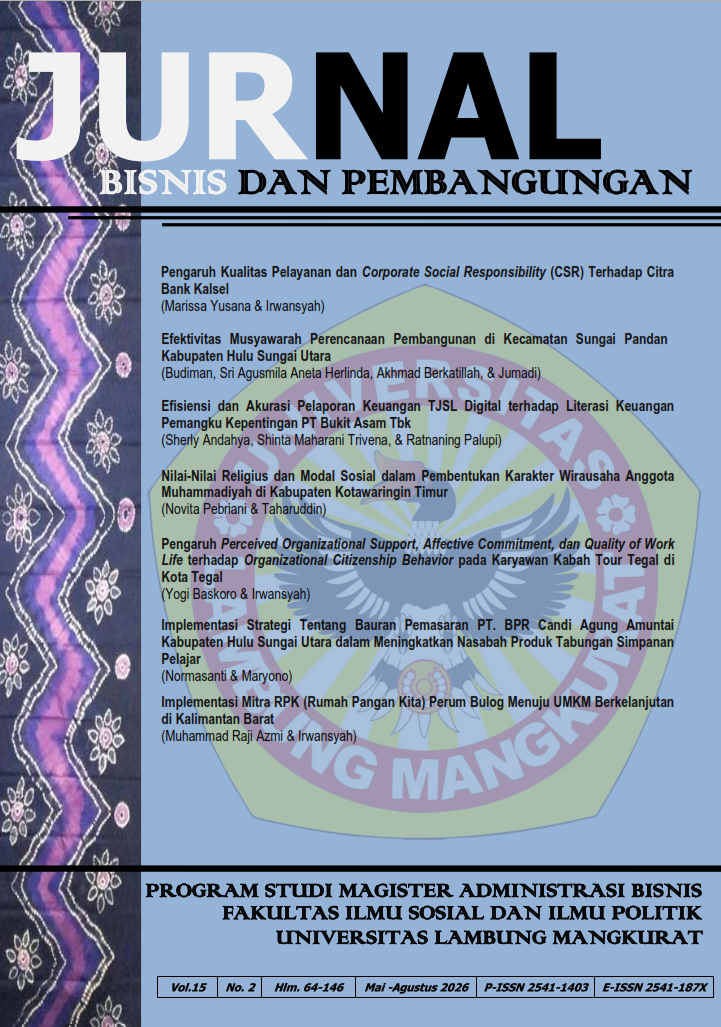
Implementasi Strategi Tentang Bauran Pemasaran PT. BPR Candi Agung Amuntai Kabupaten Hulu Sungai Utara dalam Meningkatkan Nasabah Produk Tabungan Simpanan Pelajar
DOI:
https://doi.org/10.20527/jbp.1515i2.143Keywords:
Marketing Mix Strategy, Student Savings (Simpel), Increasing Customers Of PT. BPR Candi Agung Amuntai, Banking Services MarketingAbstract
This study aims to examine the implementation of marketing strategies at PT. BPR Candi Agung regarding the increase in customers for the Student Savings (Simpel) product. The research focuses on the marketing mix elements: product, price, place, promotion, people, process, and physical evidence. This study employs a qualitative approach with a descriptive research design. Data were collected through observation, interviews, and documentation involving informants associated with marketing activities. Through this approach, the researcher gained a comprehensive overview of the company's marketing strategy implementation based on actual conditions in the field. The results indicate that the implementation of the marketing mix strategy at PT. BPR Candi Agung Amuntai, Hulu Sungai Utara Regency, to increase Simpel product customers was carried out by applying the marketing mix elements: product, price, place, promotion, people, process, and physical evidence. The strategy involved offering a Simpel product tailored to students' needs, establishing simple and affordable account opening requirements, collaborating with schools, conducting promotional and financial literacy education activities, providing friendly and fast service, and offering supportive service facilities. The implementation of this strategy contributed to an increase in the number of Simpel customers, although certain obstacles remained, such as low financial literacy among some segments of the public, limited promotional reach, and competition with other financial institutions
References
Afsar, B. (2016). Person–organization fit, perceived organizational support, and organizational citizenship behavior: The role of job embeddedness. Journal of Human Resources in Hospitality and Tourism, 15(3), 252–278. https://doi.org/10.1080/15332845.2016.1147936
Ahmad, I., & Zafar, M. A. (2018). Impact of Psychological Contract Fulfillment on Organizational Citizenship Behavior: Mediating Role of Perceived Organizational Support. International Journal of Contemporary Hospitality Management, 30(2), 1001–1015. https://doi.org/10.1108/IJCHM-12-2016-0659
Alshaabani, A., Naz, F., Magda, R., & Rudnák, I. (2021). Impact of Perceived Organizational Support on OCB in the Time of Covid-19 Pandemic in Hungary: Employee Engagement and Affective Commitment as Mediators. Sustainability (Switzerland), 13(14). https://doi.org/10.3390/su13147800
Amran, A. (2022). The Role of Perceived Organizational Support and Organizational Citizenship Behavior in Building Employee Performance. Journal of International Conference Proceedings, 5(3), 160–170. https://doi.org/10.32535/jicp.v5i3.1817
Arestia, N. (2022). Pengaruh Komitmen Afektif Terhadap Organizational Citizenship Behavior Pada Karyawan Perbankan di Pontianak. Jurnal Madani: Ilmu Pengetahuan, Teknologi, Dan Humaniora, 5(2), 55–64. https://doi.org/10.33753/madani.v5i2.214
Brahmasari, I. A. (2009). Organizational Citizenship Behavior (Ocb) Dan Isu Gender. DiE: Jurnal Ilmu Ekonomi Dan Manajemen, 5(2), 81–104. https://doi.org/10.30996/die.v5i2.44
Fala, H., Prayekti, P., & Kirana, K. C. (2021). Peran Komitmen Afektif, Kecerdasan Emosional dan Dukungan Organisasional Terhadap Organizational Citizenship Behavior Studi Pada Dinas Perindustrian dan Perdagangan DI Yogyakarta. Jurnal Ilmiah Manajemen Kesatuan, 9(1), 11–22. https://doi.org/10.37641/jimkes.v9i1.417
Fidelia, P. R. (2020). Hubungan Perceived Organizational Support (Pos) Dengan Keterlibatan Kerja Pada Perawat Kontrak Di Rsu X. Journal of Mental Health, 2(1986), 212. https://pjmh.ejournal.unsri.ac.id/index.php/Psychology_of_Mental_Health/article/view/38/
Hermawanto, A. R. (2022). Mediation Effects of Organizational Commitment between Organization Citizenship Behavior, Transformational Leadership, and Quality of Work Life. Quality - Access to Success, 23(189), 107–117. https://doi.org/10.47750/QAS/23.189.13
Hidayah, N., & Hendarsjah, H. (2021). The Impact of Quality of Work Life (QWL) and Work Motivation on The Organizational Citizenship Behavior (OCB) with Job Satisfaction as a Mediating Variables. JPPI (Jurnal Penelitian Pendidikan Indonesia), 7(3), 499–506. https://doi.org/10.29210/020211247
Islamy, F. J. (2016). Pengaruh Komitmen Afektif, Komitmen Normatif dan Komitmen Berkelanjutan terhadap Turnover Intention pada Dosen Tetap STIE Inaba Bandung (Studi Kasus pada Dosen Tetap Sekolah Tinggi Ilmu Ekonomi Indonesia Membangun Tahun 2016). Jurnal Indonesia Membangun, 15(2), 164–181.
Jehanzeb, K. (2020). Does perceived organizational support and employee development influence organizational citizenship behavior?: Person–organization fit as moderator. European Journal of Training and Development, 44(6–7), 637–657. https://doi.org/10.1108/EJTD-02-2020-0032
Kao, J. C., Cho, C. C., & Kao, R. H. (2023). Perceived Organizational Support and Organizational Citizenship Behavior–A Study of the Moderating Effect of Volunteer Participation Motivation, and Cross-Level Effect of Transformational Leadership and Organizational Climate. Frontiers in Psychology, 14(February), 1–15. https://doi.org/10.3389/fpsyg.2023.1082130
Khaola, P., & Rambe, P. (2021). The effects of transformational leadership on organisational citizenship behaviour: the role of organisational justice and affective commitment. Management Research Review, 44(3), 381–398. https://doi.org/10.1108/MRR-07-2019-0323
Khaskheli, A. (2020). Do CSR Activities Increase Organizational Citizenship Behavior Among Employees? Mediating Role of Affective Commitment and Job Satisfaction. Corporate Social Responsibility and Environmental Management, 27(6), 2941–2955. https://doi.org/10.1002/csr.2013
Lee, Y. H., Woo, B., & Kim, Y. (2018). Transformational Leadership and Organizational Citizenship Behavior: Mediating Role of Affective Commitment. International Journal of Sports Science and Coaching, 13(3), 373–382. https://doi.org/10.1177/1747954117725286
Mundung, B. I. (2021). Work Motivation and Quality of Work Life: Its Impact on Organizational Citizenship Behavior of Regional Government Office Employees of North Minahasa Regency. International Journal of Applied Business and International Management, 6(2), 68–80. https://doi.org/10.32535/ijabim.v6i2.1169
Narwastu, V. Y., Widjaja, D. C., & Setiawan, R. (2023). Pengaruh Perceived Organizational Support (POS) terhadap Organizational Citizenship Behavior (OCB) melalui Employee Development (ED) dan Organizational Commitment (OC) sebagai Variabel Mediasi pada Tenaga Kependidikan di Salah Satu Perguruan Tinggi Swasta. Jurnal Manajemen Dan Organisasi, 14(2), 139–160. https://doi.org/10.29244/jmo.v14i2.42113
Pio, R. J., & Lengkong, F. D. J. (2020). The Relationship Between Spiritual Leadership to Quality of Work Life and Ethical Behavior and Its Implication to Increasing the Organizational Citizenship Behavior. Journal of Management Development, 39(3), 293–305. https://doi.org/10.1108/JMD-07-2018-0186
Putranto, R. A., Andikaputra, F. A. T., Pradesa, H. A., & Priatna, R. (2022). Meningkatkan komitmen bagi Aparatur Sipil Negara: Perspektif teori pertukaran sosial dalam akuntabilitas organisasi publik. Fair Value: Jurnal Ilmiah Akuntansi Dan Keuangan, 5(2), 915–926. https://doi.org/10.32670/fairvalue.v5i2.1748
Ratiu, L. (2021). Knowledge hiding in emergency ambulance healthcare settings: Its mediating role in the relationship between organizational support and affective commitment and organizational citizenship behaviours. Nursing Reports, 11(4), 965–980. https://doi.org/10.3390/nursrep11040088
Sapari, Y. (2018). Komunikasi dalam Perspektif Teori Pertukaran. Jurnal Signal, 54–67.
Sari, M. S., & Zefri, M. (2019). Pengaruh Akuntabilitas, Pengetahuan, dan Pengalaman Pegawai Negeri Sipil Beserta Kelompok Masyarakat (Pokmas) Terhadap Kualitas Pengelola Dana Kelurahan Di Lingkungan Kecamatan Langkapura. Jurnal Ekonomi, 21(3), 311.
Soetjipto, H. N. (2017). Quality Work of Life. In Uki (Ed.), Buku Referensi, K-Media (April 2017). Penerbit K-Media. http://repository.stieyapan.ac.id/id/eprint/69/1/Quality Work Of Life Teori dan Implementasinya_HM. Noer Soetjipto.pdf
Sugiyono. (2013). Metode Penelitian Kuantitatif, Kualitatif, dan R&D. In Data Kualitatif (19th ed.). Penerbit Alfabeta.
Suriyana, N., Wijaya, R. A., & Kumbara, V. B. (2020). Pengaruh Tingkat Quality of Work Life (QWL), Dan Knowledge Managementt terhadap Organizing Citizenship (OCB) dengan Kepuasan Kerja sebagai Variabel Intervening pada PT. Graindo Mediatama. Jurnal Manajemen Pendidikan Dan IImu Sosial, 1(2), 548–559. https://doi.org/https://doi.org/10.38035/jmpis.v1i2.320
Zain, R. N. W., Hendriyani, C., Nugroho, D., & Ruslan, B. (2021). Implementation of CSR Activities from Stakeholder Theory Perspective in Wika Mengajar. Abiwara : Jurnal Vokasi Administrasi Bisnis, 3(1), 102–107. https://doi.org/10.31334/abiwara.v3i1.1846
Zhao, X. (2022). The Impact of Positive Verbal Rewards on Organizational Citizenship Behavior—The Mediating Role of Psychological Ownership and Affective Commitment. Frontiers in Psychology, 13. https://doi.org/10.3389/fpsyg.2022.864078
Published
Issue
Section
License
Copyright (c) 2026 Normasanti, Maryono (Author)

This work is licensed under a Creative Commons Attribution-ShareAlike 4.0 International License.