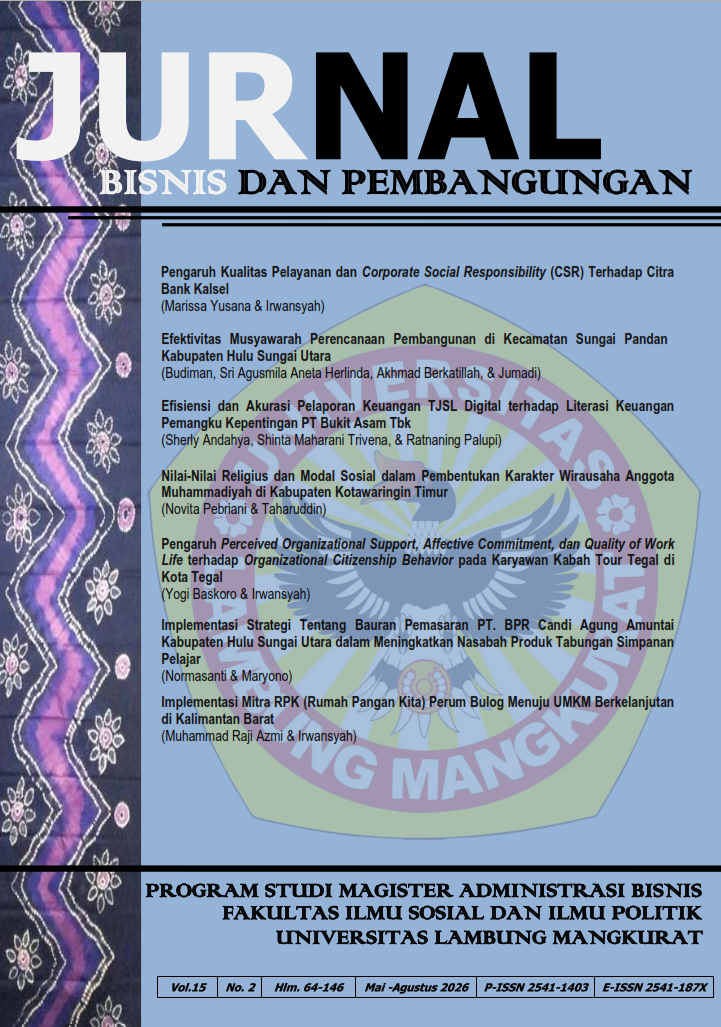
Nilai-Nilai Religius dan Modal Sosial dalam Pembentukan Karakter Wirausaha Anggota Muhammadiyah di Kabupaten Kotawaringin Timur
DOI:
https://doi.org/10.20527/jbp.1515i2.141Keywords:
Religious values, Social Capital, Entrepreneurial Character, Muhammadiyah, BourdieuAbstract
The study employed a descriptive qualitative approach with a multi-site case study design. Five informants active Muhammadiyah members running independent businesses for at least one year were selected through purposive sampling. Data were collected through in-depth interviews, observations, and documentation. Data analysis employed thematic analysis and an inductive process, with data validity tested through credibility (triangulation and member checking) and confirmability (reflexivity and audit trail). The results indicate that the dominant religious value is social benefit (mashlahah), manifested in job creation and zakat distribution. The dominant form of social capital is informal networks (WhatsApp groups and religious study groups), which proved stronger than formal forums such as SUMU and JSM that have yet to function effectively in the region. The dominant entrepreneurial character is independence. The internalization process occurs in four stages: listening, believing, practicing, and habituating. Supporting factors include the community as an initial market, the "giving hand" principle, and solidarity, while inhibiting factors include the non-functioning of SUMU/JSM and the organization's prioritization of education. Practically, this study offers input for Muhammadiyah regional leadership to activate SUMU and JSM, balance organizational priorities between education and economic empowerment, and strengthen social capital through informal networks. Theoretically, this study reinforces Bourdieu's theory that habitus is formed through the accumulation of capital within a particular field
References
Adly, A. (2023). An Islamist economic habitus: Islamist-affiliated businesses in Egypt. Contemporary Islam, 17(3), 339–361. https://doi.org/10.1007/s11562-023-00521-0
Agussalim, Wardana, & Aminullah. (2025). Entrepreneurship dalam perspektif Islam: Konsep, nilai, dan implementasi pendidikan. IQRO: Journal of Islamic Education, 8(3), 999–1014. https://doi.org/10.24256/iqro.v8i3.7555
Baggio, A. F., & Baggio, D. K. (2014). Empreendedorismo: Conceitos e definições. Revista de Empreendedorismo, Inovação e Tecnologia, 1(1), 25–38. https://doi.org/10.18256/2359-3539/REIT-IMED.V1N1P25-38
Bagis, F., Ikhsani, M. M., Muammar, M., & Darmawan, A. (2022). The antecedents of MSME performance: From characteristics of Islamic entrepreneurs perception. International Journal of Economics, Business and Accounting Research (IJEBAR), 6(2), 1543–1550. https://doi.org/10.29040/ijebar.v6i2.5780
Bandura, A. (1977). Social learning theory. Prentice Hall.
Bilqis, A. H., & Afmadesikha, N. (2025). Integrasi nilai syariah dalam praktik kewirausahaan Islami: Tinjauan hablumminallah dan hablumminannas. Jurnal Ekonomi Bisnis dan Kewirausahaan, 2(3), 70–78. https://doi.org/10.69714/z8ce2e32
Bourdieu, P. (1986). The forms of capital. In J. Richardson (Ed.), Handbook of theory and research for the sociology of education (pp. 241–258). Greenwood Press.
Cloete, A. L. (2014). Social cohesion and social capital: Possible implications for the common good. Verbum et Ecclesia, 35(3), 1–10. https://doi.org/10.4102/ve.v35i3.1331
Fusch, P. I., & Ness, L. R. (2015). Are we there yet? Data saturation in qualitative research. The Qualitative Report, 20(9), 1408–1416.
Habibi, N., & Sholikha, M. (2025). Kontekstualisasi Teori Bourdieu dalam Pembentukan Karakter Santri di Pondok Pesantren Darul Falah Amtsilati. DIMAR: Jurnal Pendidikan Islam, 6(2), 261–273. https://doi.org/10.58577/dimar.v6i2.397
Hakim, I., Sarif, M., & Rofiq, A. (2022). Economic empowerment through Muhammadiyah-owned enterprises: A case study of Muhammadiyah Regional Board of Lumajang. Inferensi: Jurnal Penelitian Sosial Keagamaan, 16(2), 195–216. https://doi.org/10.18326/infsl3.v16i2.195-216
Hall, S., & Liebenberg, L. (2024). Qualitative Description as an Introductory Method to Qualitative Research for Master's-Level Students and Research Trainees. International Journal of Qualitative Methods, 23. https://doi.org/10.1177/16094069241242264
Istifhama, L. (2022). Business Resilience of the Muslim Merchants through of Social Capital. International Journal of Islamic Thought and Humanities, 1(2), 156–168. https://doi.org/10.54298/ijith.v1i2.71
Juliarsih, R., Gustin, M. A., Melisa, D., Novitasari, F., & Lidia, V. (2025). Internalizing Dayak cultural values to foster youth entrepreneurial interest in local economic development. Implementasi Manajemen & Kewirausahaan, 5(1), 62–74. https://doi.org/10.38156/imka.v5i1.538
Khairani, I., Imsar, & Nasution, M. L. I. (2023). Analysis of the contribution of Islamic social capital to increasing MSMEs. Journal of Islamic Economics and Finance Studies, 4(1). https://doi.org/10.47700/jiefes.v4i1.8923
Kyngäs, H., Kääriäinen, M., & Elo, S. (2020). The trustworthiness of content analysis. In The application of content analysis in nursing science research (pp. 41–48). Springer. https://doi.org/10.1007/978-3-030-30199-6_5
Masita, D., Melinda, M., & Firmansyah, M. R. (2026). Producing loyalty: Social networks, religious legitimacy, and ethnic business strategies in Pasuruan local retail economies. KOSISTEM: Journal of Economics, Business, and Contemporary Tourism, 1(2), 187–202.
Moergen, K. J. N., Hayman, M. G., Cummings, M., & Pidduck, R. J. (2025). Founders' Social Class Origin, Risk-Taking, and Venture Performance: A Bourdieusian Lens. Entrepreneurship Theory and Practice. https://doi.org/10.1177/10422587251371486
Mundzir, M., Muttaqin, Z., Nadia, M. A., & Muttaqin, A. (2024). Islamic sociopreneurship: Prophetic principles and BAZNAS's approach in empowering mustahik. Economica: Jurnal Ekonomi Islam, 15(2), 135–158. https://doi.org/10.21580/economica.2024.15.2.22509
Nadhifah, T., Rosita, D., Risnawati, H., Yudiana, A., & Ristina, L. (2025). Spiritual profile of Muslim entrepreneurs in MSMEs: A study of Islamic boarding school-based entrepreneurship. IECON: International Economics and Business Conference, 3(2), 1813–1816. https://doi.org/10.65246/ade8s379
Neuendorf, K. A. (2018). Content analysis and thematic analysis. In Research Methods for Media and Communication (pp. 211–223). Routledge. https://doi.org/10.4324/9781315517971-21
Palamarchuk, O., Fasolko, T., Botsian, T., Kashchuk, K., Klimova, I., & Bezchotnikova, S. (2022). Personal responsibility as a problem of development of postmodern society. Postmodern Openings, 13(1), 396–412. https://doi.org/10.18662/po/13.1/396
Pargito, Arif, A., & Saptaningtyas, H. (2025). Social capital and resilience of Dawar Islamic School and its roles to support santri alumni's socioeconomic independence. Journal of Social Politics and Governance, 7(2). https://doi.org/10.24076/5r1rba14
Portes, A. (1998). Social capital: Its origins and applications in modern sociology. Annual Review of Sociology, 24(1), 1–24. https://doi.org/10.1146/annurev.soc.24.1.1
Putnam, R. D. (2000). Bowling alone: The collapse and revival of American community. Simon & Schuster.
Rahmadanti, A., Trihapsary, A., Bancin, N. D. Y., Munthe, M. A., Wismanto, W., & Ramashar, W. (2024). Peran Muhammadiyah dalam Pengembangan Kewirausahaan di Indonesia. Jurnal Budi Pekerti Agama Islam, 3(1), 123–131. https://doi.org/10.61132/jmpai.v3i1.832
Robani, A., Ahamat, A., Hassan, S. N. S., Latief, H., & Pratiwi, A. (2022). Islamic solidarity economy: the case study of social entrepreneurship in Pesantren, Indonesia. Middle East Journal of Management, 9(6), 665–681.
Setyawan, D. (2017). Moving ijtihad and tajdid on Amal Usaha Muhammadiyah (AUM) in building the civilization of Islamic economy. Addin, 11(1), 77–100. https://doi.org/10.21043/ADDIN.V11I1.1904
Stringfellow, L., Shaw, E., & Maclean, M. (2014). Apostasy versus legitimacy: relational dynamics and routes to resource acquisition in entrepreneurial ventures. International Small Business Journal, 32(5), 571–592. https://doi.org/10.1177/0266242612471693
Umami, N., Pratikto, H., & Winarno, A. (2024). Beyond profit: A pedagogical model for integrating philosophy into economic education for value-based entrepreneurship in Indonesia. Enigma in Education, 2(2), 100–113. https://doi.org/10.61996/edu.v2i2.81
Vears, D. F., & Gillam, L. (2022). Inductive content analysis: A guide for beginning qualitative researchers. Focus on Health Professional Education: A Multi-Professional Journal, 23(1), 111–127. https://doi.org/10.11157/fohpe.v23i1.544
Wattanakomol, S., & Silpcharu, T. (2023). Characteristics of entrepreneurs in sustainably successful micro, small, and medium enterprises. Uncertain Supply Chain Management, 11(3), 1359–1368. https://doi.org/10.5267/j.uscm.2023.3.012
Wibowo, E. Y. (2017). Islam dan Kewirausahaan: Dinamika Sosial Ekonomi Komunitas Pengrajin Batik di Karangkajen Yogyakarta (1950-1975). JUSPI (Jurnal Sejarah Peradaban Islam), 1(1), 112–138. https://doi.org/10.30829/J.V1I1.1003
Downloads
Published
Issue
Section
License
Copyright (c) 2026 Novita Pebriani, Taharuddin (Author)

This work is licensed under a Creative Commons Attribution-ShareAlike 4.0 International License.