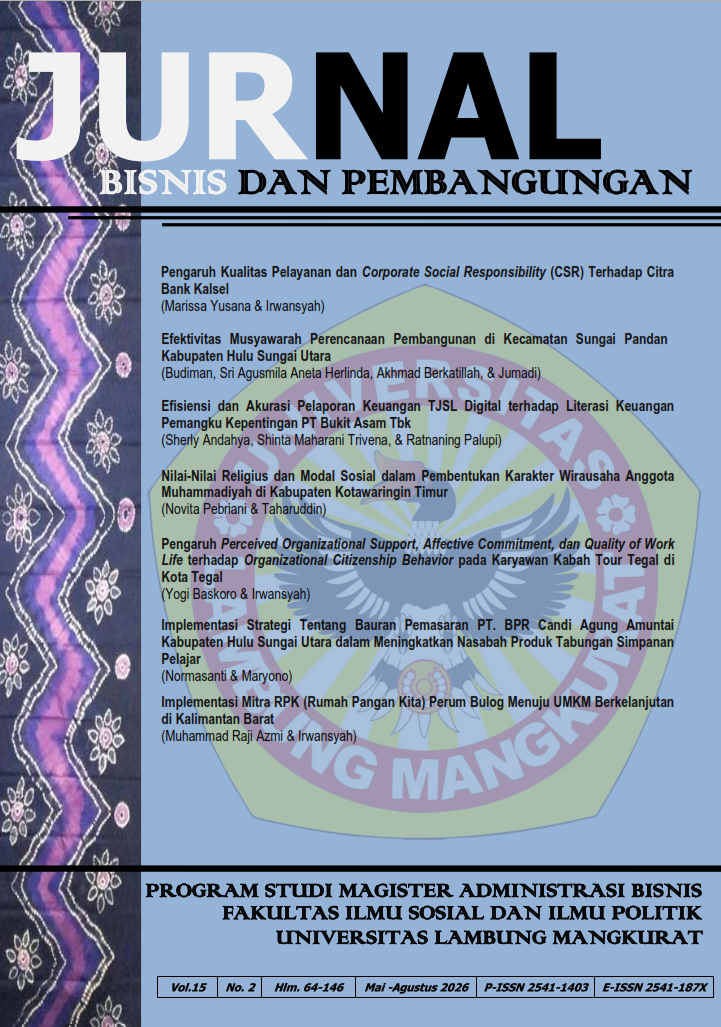
Efisiensi dan Akurasi Pelaporan Keuangan TJSL Digital terhadap Literasi Keuangan Pemangku Kepentingan PT Bukit Asam Tbk
DOI:
https://doi.org/10.20527/jbp.1515i2.131Keywords:
Financial Reporting Accuracy, SIAP TJSL, Financial Literacy, Stakeholder Theory, Document DigitalizationAbstract
Research on accounting information system digitalization typically stops at internal efficiency and accuracy, rarely extending to the question of whether improved internal reporting quality translates into better comprehension by external parties. This gap is evident in Corporate Social and Environmental Responsibility (TJSL) reporting by Indonesian state-owned enterprises (SOEs) in the mining sector, where local communities and regional governments are the primary stakeholders who need to understand these reports. Employing a qualitative case study approach, this study analyzes the effectiveness of document digitalization through the Program Accounting Information System (SIAP) TJSL on financial reporting efficiency and accuracy, and examines its implications for stakeholder financial literacy at PT Bukit Asam Tbk. Data were collected through in-depth interviews with five informants at the Sustainability Accounting and Finance Division, three months of direct observation, and analysis of internal documents at PT Bukit Asam Tbk for 2024-2025. Findings show reporting time decreased from 7-14 to 2-3 working days and accuracy improved from 75-80 to 92-96 percent. A critical finding reveals that automatic format validation cannot detect nominal value errors that are technically correct in format but wrong in value, leaving a 4-8 percent error rate. Grounded in stakeholder theory, this improvement contributes to stakeholder financial literacy through three mechanisms, though the external data accessibility mechanism remains limited because SIAP TJSL data does not yet fully meet Global Reporting Initiative (GRI) standards. This study contributes a novel conceptual distinction between technical and substantive reporting accuracy and provides the first empirical account of how a digital TJSL reporting system in an Indonesian mining SOE shapes external stakeholder financial literacy
References
Christensen, H. B., Hail, L., & Leuz, C. (2021). Mandatory CSR and sustainability reporting: Economic analysis and literature review. Review of Accounting Studies, 26(3), 1176-1248. https://doi.org/10.1007/s11142-021-09609-5
Dmytriyev, S. D., Freeman, R. E., & Horisch, J. (2021). The relationship between stakeholder theory and corporate social responsibility: Differences, similarities, and implications for social issues in management. Journal of Management Studies, 58(6), 1441-1470. https://doi.org/10.1111/joms.12684
Freeman, R. E. (1984). Strategic Management: A Stakeholder Approach. Boston: Pitman Publishing.
Lusardi, A., & Mitchell, O. S. (2014). The economic importance of financial literacy: Theory and evidence. Journal of Economic Literature, 52(1), 5-44. https://doi.org/10.1257/jel.52.1.5
Miles, M. B., Huberman, A. M., & Saldana, J. (2014). Qualitative Data Analysis: A Methods Sourcebook (3rd ed.). Thousand Oaks: SAGE Publications.
Yin, R. K. (2018). Case Study Research and Applications: Design and Methods (6th ed.). Thousand Oaks: SAGE Publications.
Asmira, N., & Sulkiah. (2025). The implementation of accounting digitalization and internal control on the quality of financial reports. E-Jurnal Akuntansi, 35(6). https://doi.org/10.24843/EJA.2025.v35.i06.p20
Gunawan, J., Permatasari, P., & Fauzi, H. (2022). The evolution of sustainability reporting practices in Indonesia. Journal of Cleaner Production, 358, 131798. https://doi.org/10.1016/j.jclepro.2022.131798
Kusumawardhani, F. K., Ratmono, D., Wibowo, S. T., Darsono, D., Widyatmoko, S., & Rokhman, N. (2024). The impact of digitalization in accounting systems on information quality, cost reduction and decision making: Evidence from SMEs. International Journal of Data and Network Science, 8(2), 1111-1116. https://doi.org/10.5267/j.ijdns.2023.11.023
Laporan Tahunan PT Bukit Asam Tbk. (2024). Energi Tanpa Henti, Terus Tangguh Menatap Masa Depan. Tanjung Enim: PT Bukit Asam Tbk.
Meiryani, Huang, S. M., Soepriyanto, G., Fahlevi, M., Grabowska, S., Grima, S., & Aljuaid, M. (2023). The effect of voluntary disclosure on financial performance: Empirical study on manufacturing industry in Indonesia. PLOS ONE, 18(6), e0285720. https://doi.org/10.1371/journal.pone.0285720
Otoritas Jasa Keuangan. (2024). Hasil Survei Nasional Literasi dan Inklusi Keuangan 2024. Jakarta: OJK.
Sopianti, Y., Lalenoh, S., & Ramadhan, Y. (2025). Transformation of the role of accountants in the digital era: A literature review on the impact of data analytics in financial reporting. Indonesian Interdisciplinary Journal of Sharia Economics, 9(1), 184-192.
Waheed, A., & Zhang, Q. (2022). Effect of CSR and ethical practices on sustainable competitive performance: A case of emerging markets from stakeholder theory perspective. Journal of Business Ethics, 175(4), 837-855. https://doi.org/10.1007/ s10551-020-04679-y.
Downloads
Published
Issue
Section
License
Copyright (c) 2026 Sherly Andahya, Shinta Maharani Trivena, Ratnaning Palupi (Author)

This work is licensed under a Creative Commons Attribution-ShareAlike 4.0 International License.