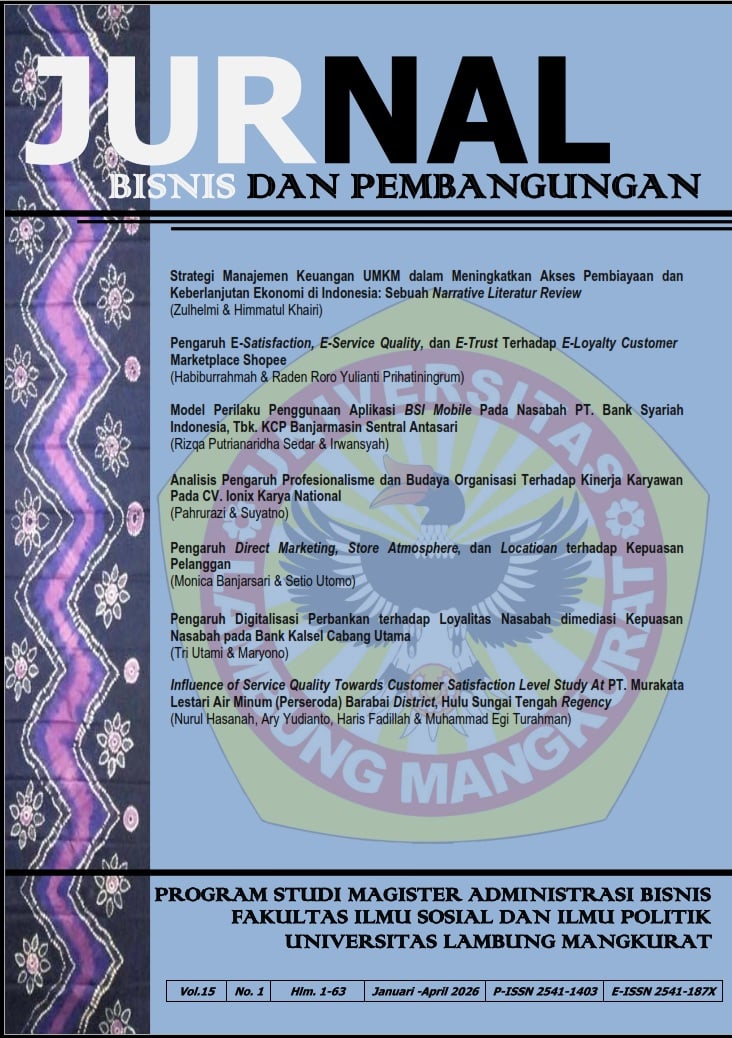
Model Perilaku Penggunaan Aplikasi BSI Mobile Pada Nasabah PT. Bank Syariah Indonesia, Tbk. KCP Banjarmasin Sentral Antarari
DOI:
https://doi.org/10.20527/jbp.1515i1.124Keywords:
Sharia Bank, Mobile banking,, Technology Acceptance Model (TAM)Abstract
This research aims to examine the behavior of BSI KCP Banjarmasin Sentra Antasari customers in using mobile banking using the Technology Acceptance Model (TAM). The TAM model consists of the variables perceived ease, perceived usefulness, attitude to use, interest in use, and using. The study employs a quantitative research method with an explanatory type and utilizes SmartPLS data analysis. Data is collected through the distribution of questionnaires to BSI customers at KCP Banjarmasin Sentra Antasari who use the BSI Mobile application. The results of this test prove that perceived ease of use has a positive effect on attitudes towards using mobile banking, perceived usefulness has a positive effect on attitudes towards using mobile banking, attitudes towards use have a positive effect on behavioral interest in using mobile banking, and behavioral interest has a positive effect on using mobile banking
References
Aldino. (2013). Technology Acceptance Model dalam sistem informasi.
Arikunto, S. (2002). Prosedur Penelitian: Suatu Pendekatan Praktik. Jakarta: Rineka Cipta.
Arikunto, S. (2006). Metodologi Penelitian. Jakarta: Rineka Cipta.
Chaffey, D., & Smith, P. R. (2013). Emarketing Excellence: Planning and Optimizing Your Digital Marketing. Routledge.
Cruz, P., Neto, L. B. F., Muñoz-Gallego, P., & Laukkanen, T. (2010). Mobile banking rollout in emerging markets. International Journal of Bank Marketing, 28(5), 342–371.
Davis, F. D. (1989). Perceived usefulness, perceived ease of use, and user acceptance of information technology. MIS Quarterly, 13(3), 319–340.
DeYoung, R., Lang, W. W., & Nolle, D. L. (2007). How the Internet affects output and performance at community banks. Journal of Banking & Finance, 31(4), 1033–1060.
Febriawan, D. (2013). Pengaruh perceived ease of use terhadap attitude toward use sistem e-learning.
Hendika. (2011). Sejarah perkembangan internet banking.
Hernando, I., & Nieto, M. J. (2007). Is the Internet delivery channel changing banks’ performance? Journal of Banking & Finance, 31(4), 1083–1099.
Kotler, P., & Keller, K. L. (2016). Marketing Management (15th ed.). Pearson.
Laukkanen, T., & Lauronen, J. (2005). Consumer value creation in mobile banking services. International Journal of Mobile Communications, 3(4), 325–338.
Lin, H. F. (2013). Determinants of customer adoption of mobile banking. International Journal of Mobile Communications, 11(6), 593–613.
Nsouli, S. M., & Schaechter, A. (2002). Challenges of the e-banking revolution. Finance & Development, 39(3).
Oladipupo, O. (2014). Technology acceptance model and user behavior.
Polatoglu, V. N., & Ekin, S. (2001). An empirical investigation of the Turkish consumers’ acceptance of internet banking services. International Journal of Bank Marketing, 19(4), 156–165.
Rahmawaty, A. (2012). Pengaruh minat perilaku terhadap penggunaan internet banking.
Shaikh, A. A., & Karjaluoto, H. (2015). Mobile banking adoption: A literature review. Telematics and Informatics, 32(1), 129–142.
Sugiyono. (2001). Statistika untuk Penelitian. Bandung: Alfabeta.
Turban, E. (2004). Electronic Commerce: A Managerial Perspective. Pearson
Downloads
Published
Issue
Section
License
Copyright (c) 2026 Rizqa Putrianaridha Sedar, Irwansyah (Author)

This work is licensed under a Creative Commons Attribution-ShareAlike 4.0 International License.